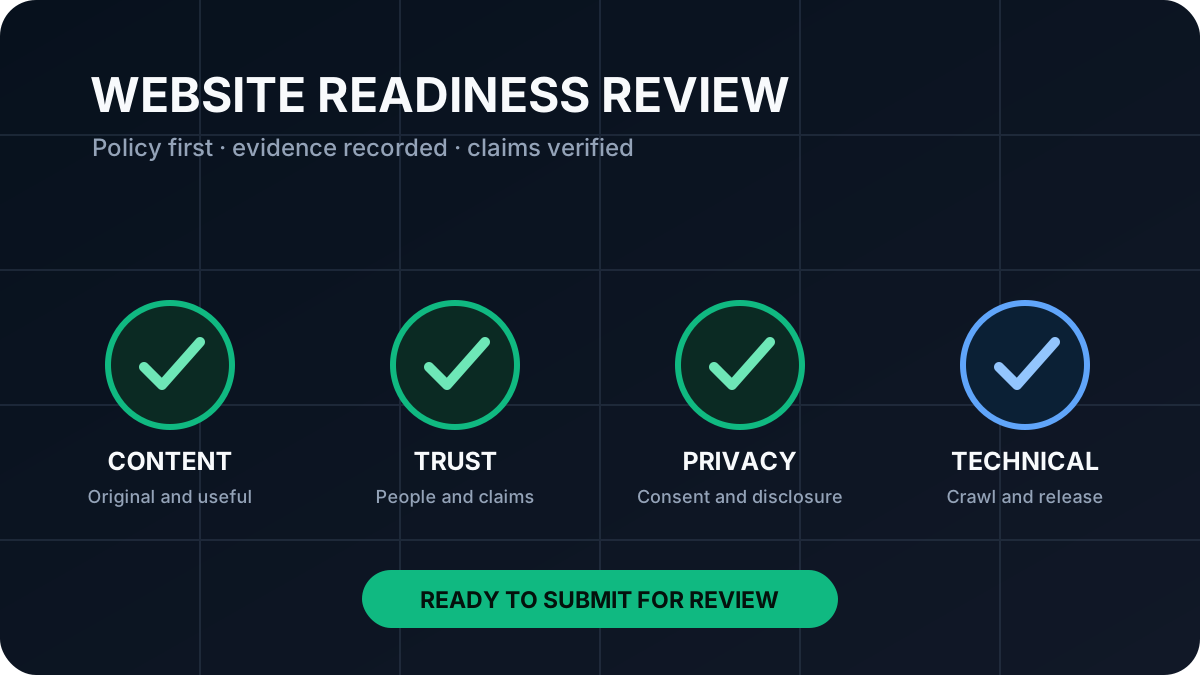
An AdSense application is not approved because a site has a privacy-policy link, a particular number of posts or a perfect audit score. Google reviews the site for policy compliance and usefulness, and Google alone makes the decision. The practical objective is therefore narrower and more honest: remove avoidable rejection signals, document what remains, and submit only when the live site matches the evidence.
Start with the correct claim
No consultant, plugin or checklist can confirm approval in advance. Google's site-approval guidance says the entire site is reviewed and that approval must occur before ads can be shown. The same guidance notes that review often takes days and may take weeks. Treat “ready to submit” as an audited state, not a promise about Google's decision.
A useful readiness record separates three things: confirmed facts about the live site, inferences about review risk, and account actions that only the publisher can complete. Mixing them produces false confidence.
Gate 1: the public content inventory
List every route that a visitor or crawler can reach in production. Do not stop at the navigation menu. Include old URLs, tag pages, search results, author archives, tools, downloads, login surfaces, error pages and generated landing pages.
For every URL, record its purpose, publication owner, last review date, evidence status, indexability and whether advertising is permitted. A page should not become public merely because it exists in a content system. Google's Publisher Policies prohibit Google-served ads on screens with no publisher content or low-value content, and on replicated content that lacks meaningful added value.
Programmatic scale deserves an adversarial check. Search Central defines scaled content abuse as generating many pages primarily to manipulate rankings rather than help users. Its spam policy applies regardless of whether automation, AI or people produced the pages. A safe editorial gate should require a human-reviewed release state and should prevent draft URLs from returning a production 200 response.
Questions for each candidate page
- Does it answer a real question for the site's intended audience?
- Does it contain original analysis, experience, a tool, evidence or another reason to prefer it over a generic summary?
- Can a reader identify who created or reviewed it and how to report an error?
- Are statistics, dates, testimonials, awards and client outcomes supported and current?
- Do the title, description, body and links accurately describe what the visitor receives?
Google's people-first content guidance recommends evaluating originality, completeness, authorship, expertise and the “who, how and why” behind content. It also states that Google has no preferred word count. Adding filler to reach a supposed threshold is not a quality strategy.
Gate 2: trust and navigation
Review the site as a skeptical visitor. Can they identify the operator, understand the site's purpose, find a working contact route and move through the main content without dead ends or misleading labels? Google's explanation of common non-approval reasons specifically calls out insufficient original content, incomplete sites and difficult navigation.
Remove fabricated testimonials, placeholder logos, invented press coverage, unavailable downloads and “book now” links that do not book anything. A small site with accurate content is more defensible than a large site that asks reviewers to decide which claims are real.
Test every visible navigation path on desktop and mobile. Unknown URLs should return a real 404 response with a noindex directive. Pages that are private, empty, under construction or used only for alerts and navigation should not receive ad code.
Gate 3: ownership, crawlability and connection
The applicant must own or control the site and be able to place the required connection code in the HTML source. Google's site-ownership guidance makes that access requirement explicit.
Verify the production origin, canonical URLs, HTTPS behavior, robots rules, XML sitemap, internal links and status codes from the deployed site—not only from a development preview. Do not block content on which ads will appear from Google's crawler; ad-placement guidance notes that Google may disable ad serving on content it cannot evaluate.
Use the publisher identifier issued inside the applicant's own AdSense account. A build can validate its format and produce the connection meta tag, but it must never invent or copy another publisher's identifier.
Gate 4: privacy and regional consent
A current privacy policy must describe the data collection, sharing and technologies that actually occur when Google products are used. Google's cookie guidance says AdSense publishers must clearly display a privacy policy notifying visitors about cookie use. The broader Publisher Policies require disclosure of cookies, web beacons, IP addresses or other identifiers associated with ad serving.
A generic cookie banner is not automatically an advertising-compliant consent platform. Google requires publishers serving personalized ads in the EEA, the UK and Switzerland to use a Google-certified CMP integrated with the IAB Transparency and Consent Framework. Review the current CMP requirement for publishers, choose the implementation in the AdSense account, publish it, and test regional consent behavior before enabling personalized ads.
Gate 5: ads.txt and ad implementation
When AdSense supplies the real publisher ID, place the matching seller declaration at the root domain. Google's ads.txt crawler guidance says the file should return HTTP 200, use the exact publisher ID and contain valid plain-text formatting. An invented placeholder is worse than a deliberately absent file before the real ID exists.
Do not enable ad-serving scripts merely to make the site look monetized. First choose which reviewed content templates may show ads, configure consent, update the content-security policy and privacy disclosures, and then test placements. Google's Program policies prohibit encouraging clicks, disguising ads as navigation or downloads, and using site behavior that interferes with navigation.
Placement review questions
- Is the ad clearly distinguishable from editorial content and interface controls?
- Could a tap intended for a menu, form, calculator or download land on an ad?
- Does the page contain substantially more publisher content than advertising or promotion?
- Is the route public, reviewable and eligible for monetization?
- Can the layout reflow without an ad covering content or pushing the primary task off screen?
A defensible submission sequence
- Freeze the public route inventory and remove draft or misleading surfaces from production.
- Complete a human content, claims, navigation, accessibility and mobile review.
- Deploy and verify canonical URLs, status codes, robots.txt, sitemap.xml, security headers and forms on the real domain.
- Confirm the applicant is eligible, owns the site and uses the exact account-issued publisher ID.
- Connect the site using the method shown in AdSense and submit it for review.
- After approval, configure the certified CMP and privacy disclosures, choose eligible templates, add ad code and test placements without clicking live ads.
- Monitor traffic quality, policy messages, crawler access and content changes after launch.
What remains outside a code audit
A repository can prove that safeguards exist in a particular build. It cannot prove the applicant's age, identity, account standing, domain ownership, live DNS, publisher ID, consent-platform configuration, traffic quality or Google's final judgment. Record those as owner-verified release gates. A readiness report that hides them is less useful than one that marks them clearly.
Editorial note: This article is an independent synthesis of the official sources linked above. It is not legal advice, is not affiliated with Google and does not guarantee AdSense approval.